
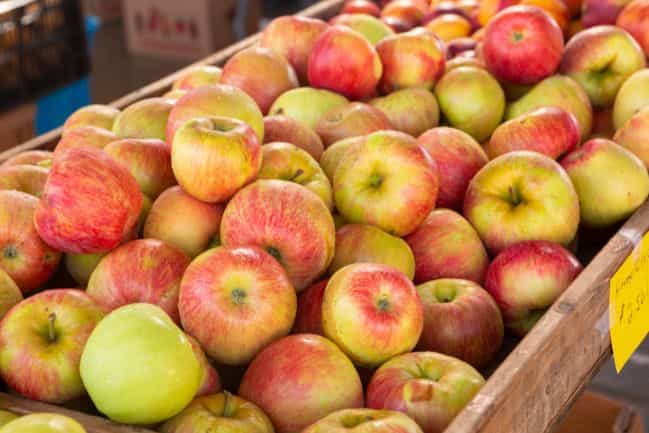
The Honeycrip almost never was
In the early 1960s, the apple world was trapped in a reign of red, waxy mediocrity. Supermarket shelves across North America were dominated by the Red Delicious—a fruit bred relentlessly for deep crimson color and long shelf life at the direct expense of flavor and texture. Its skin was thick, tough, and bitter; its flesh was soft, dry, and mealy. Eating an apple had become an act of chore-like duty rather than pleasure.
Eighty miles northwest of Minneapolis, at the University of Minnesota’s Horticultural Research Center in Excelsior, researchers were fighting a completely different battle. The primary challenge for Upper Midwest orchardists wasn’t merely growing a tastier apple—it was survival. Cold Minnesota winters routinely dipped below minus thirty degrees Fahrenheit, killing off tender commercial apple trees before they could ever bear fruit. Breeders were tasked with creating winter-hardy varieties that could withstand arctic gusts without turning into brittle firewood.
In 1960, a university researcher named Harlan Marks made a routine series of cross-pollinations between two sturdy parent trees. By convention, the seedling was labeled with a lineage thought to be ‘Macoun’ crossed with ‘Honeygold.’ The resulting seeds were planted, sprouted, and eventually transferred to an experimental orchard as tree designation MN 1711.
For years, MN 1711 grew quietly alongside thousands of other hopeful specimens. Plant breeding is an exhausting game of patience and ruthless elimination: thousands of unique trees are planted, evaluated, and discarded if they fail to display exceptional traits. By 1977, MN 1711 had fallen on hard times. It suffered severe winter injury and showed signs of disease susceptibility. Deemed a weak performer, it was slated to be cut down and discarded.
Enter David Bedford, a young horticulturalist hired in 1979 to manage the university’s apple breeding program alongside head fruit breeder Dr. James Luby. When Bedford walked the university orchards, he noticed a seedling that had miraculously sprouted from the rootstock of the nearly dead MN 1711 tree. It had survived the culling simply because no one had gotten around to digging out its stump. Curious, Bedford allowed the tree to fruit.
A few autumns later, Bedford plucked a mottled, yellow-and-red fruit from the regenerated branch and took a bite.
The sound was sharp enough to turn heads in the orchard. It didn’t yield with the dull, soft thud of a grocery-store apple; it cracked like breaking ice. Instead of chewing into a dry paste, Bedford experienced a sudden burst of sweet-tart juice that practically poured out of the flesh.
Bedford and Luby quickly realized they weren’t holding just another cold-hardy apple—they were holding a sensory revolution. What made MN 1711 unique wasn’t merely its balanced sugar-to-acid ratio; it was its microscopic cellular architecture. Most standard apples contain smaller, compact plant cells that tear apart along their walls when bitten, producing a mushy sensation. MN 1711, however, possessed cells nearly double the normal size. When teeth punctured the surface, these massive, water-filled cells didn’t just separate—they fractured and burst open under pressure, detonating juice into the mouth.
Recognizing its commercial potential, Luby and Bedford began propagating clones of the tree across multiple test orchards. In 1988, the university filed for a plant patent, and in 1991, MN 1711 was officially introduced to the public under the name Honeycrisp.
Commercial growers were initially skeptical. To an orchardist, Honeycrisp is an agronomic nightmare. The trees are finicky and prone to nutrient deficiencies, particularly bitter pit caused by low calcium absorption. The fruit ripens unevenly, requiring farmworkers to pick the same tree three or four times over a season. Furthermore, the skin is so delicate that stems must be clipped by hand so they don’t puncture neighboring apples in harvest crates.
Yet when consumers tasted the apple at local farmers’ markets and regional grocery stores in the late 1990s, the market exploded. Shoppers didn’t care that the apples looked slightly irregular or striped; they cared that an apple finally tasted alive. Demand skyrocketed to such an extent that Honeycrisp routinely commanded three to four times the price per pound of conventional varieties—a premium unheard of in the commodity produce aisle.
The popularity of Honeycrisp completely reshuffled the modern apple economy, saving hundreds of family orchards from bankruptcy and forcing competitors to breed entirely new crisp-textured varieties like Cosmic Crisp and SweeTango. Decades later, DNA fingerprinting revealed one final twist in the tale: the original breeder notes from 1960 were incorrect. Honeycrisp was not a cross between Macoun and Honeygold at all, but rather the offspring of Keepsake and an unreleased seedling known only as MN 1627.
What began as an abandoned tree marked for the woodpile had redefined what people expected from an apple, proving that one lucky bite can shatter an entire industry.